
The Ultimate Lash Tweezer Guide: Fibre Tip vs Non-Fibre Tip & Every Tweezer Style Explained
The Ultimate Lash Tweezer Guide: Fibre Tip vs Non-Fibre Tip & Every Tweezer Style Explained
Welcome to the ultimate lash tweezer guide by Phatlash! Whether you're a beginner lash technician building your first lash kit or an experienced lash artist looking to upgrade your tools, choosing the right tweezers can make a huge difference to your application.
At Phatlash, we know that having the right tools is essential for creating beautiful lash sets. From classic lashes to Russian volume, your tweezers play an important role in how you isolate natural lashes, pick up extensions and create your finished look.
But with so many different styles available, how do you know which tweezers are right for you?
In this guide, we're breaking down everything you need to know about lash tweezers, including the difference between fibre tip and non-fibre tip tweezers, the different shapes available and which styles may suit your lash technique.
We'll cover:
-
Fibre tip vs non-fibre tip tweezers.
-
Straight and isolation tweezers.
-
Angled lash tweezers.
-
Curved lash tweezers.
-
Boot lash tweezers.
-
90-degree lash tweezers.
-
How to choose the right tweezers for your technique.
-
How to look after your lash tweezers.
By the end of this guide, you'll have a better understanding of the different tweezer styles and what to look for when choosing your next pair from Phatlash.
Why Are Lash Tweezers So Important?
If you're a lash technician, you'll know that your tweezers are one of the most important tools in your lash kit.
Lash tweezers are specially designed to help you work with individual natural lashes and lightweight lash extensions. They allow you to isolate natural lashes, pick up extensions, create handmade volume fans and place extensions accurately.
Using the right tweezers can help you:
-
Improve your isolation and prevent natural lashes from sticking together.
-
Pick up individual lash extensions with greater control.
-
Create consistent volume fans.
-
Work more comfortably during appointments.
-
Apply extensions accurately.
-
Reduce unnecessary strain on your fingers and hands.
At Phatlash, we understand that every lash technician has their own preferred technique. Some artists love a straight tweezer for isolation, while others prefer a curved or boot tweezer for volume fans.
There isn't one tweezer style that is perfect for everyone. The best choice depends on your technique, the type of extensions you're applying and what feels comfortable in your hand.
That's why understanding the different styles is so important before choosing your next pair.
Fibre Tip vs Non-Fibre Tip Lash Tweezers
One of the first things to consider when shopping for lash tweezers at Phatlash is whether you prefer fibre tip or non-fibre tip tweezers.
Both types are designed to help you pick up and apply lash extensions, but their gripping surfaces are different.
What Are Fibre Tip Lash Tweezers?
Fibre tip tweezers have a specially textured gripping surface at the tips. This texture is designed to help the tweezers hold onto lash extensions securely.
They are particularly popular with lash technicians who create handmade volume fans because the additional grip can help when picking up and manipulating multiple fine extensions.
If you regularly create Russian volume sets, fibre tip tweezers may be worth considering when choosing your next pair from Phatlash.
Benefits of Fibre Tip Tweezers
1. Additional grip
The textured surface is designed to help grip extensions securely, which can be useful when working with fine lashes.
2. Helpful for volume techniques
When creating handmade fans, you need to pick up several extensions and control their placement. A secure grip can help you maintain control while forming the fan.
3. Useful for lightweight extensions
Fibre tip tweezers may be particularly helpful when working with lightweight volume extensions, where maintaining a secure grip is important.
4. A popular choice for handmade fans
Many lash artists prefer fibre tip tweezers for volume work because of the additional grip they can provide.
Are Fibre Tip Tweezers Better?
Not necessarily!
Although fibre tip tweezers can provide additional grip, that doesn't automatically make them the best choice for every lash technician.
Some artists love the textured finish, while others prefer smooth non-fibre tip tweezers.
At Phatlash, we recommend choosing your tweezers based on your preferred technique and how comfortable they feel when you're working.
It's also important to remember that fibre tips won't compensate for poor tweezer alignment. Your tweezers should still close evenly and comfortably.
What Are Non-Fibre Tip Lash Tweezers?
Non-fibre tip tweezers have smooth gripping surfaces rather than the textured finish found on fibre tip tweezers.
They are a traditional choice for lash technicians and are available in a range of shapes, including straight, angled, curved and volume styles.
Depending on their design, non-fibre tip tweezers can be used for isolation, classic application and volume techniques.
Benefits of Non-Fibre Tip Tweezers
1. Smooth gripping surface
The smooth tips allow you to pick up and manipulate extensions without the additional texture of fibre tips.
2. Suitable for different techniques
Depending on the style, non-fibre tip tweezers can be used for classic lashes, isolation and volume application.
3. Available in different shapes
At Phatlash, you can explore different tweezer styles to find a shape that suits your preferred lash technique.
4. A familiar choice for many lash artists
Many technicians learn using traditional smooth-tip tweezers and continue using them throughout their careers.
Which Should You Choose: Fibre Tip or Non-Fibre Tip?
The best choice depends on your technique and personal preference.
|
Feature |
Fibre tip |
Non-fibre tip |
|---|---|---|
|
Tip finish |
Textured gripping surface |
Smooth gripping surface |
|
Main benefit |
Additional grip |
Traditional smooth grip |
|
Popular use |
Handmade volume fans |
Classic, isolation and volume, depending on shape |
|
Best for |
Artists who prefer extra grip |
Artists who prefer smooth tips |
Our Phatlash tip: You don't have to stick to one type! You may find that fibre tip tweezers work best for creating volume fans, while smooth non-fibre tweezers feel more comfortable for isolation or classic application.
Many lash technicians keep different tweezers in their kit so they can switch between styles throughout an appointment.
The Different Types of Lash Tweezers Explained
Now that we've covered fibre tip and non-fibre tip tweezers, let's look at the different styles available.
At Phatlash, we know that choosing the right tweezer shape can feel confusing, especially when you're just starting your lash journey.
Each style has its own design and potential uses. Some are particularly useful for isolation, while others are popular for picking up extensions and creating volume fans.
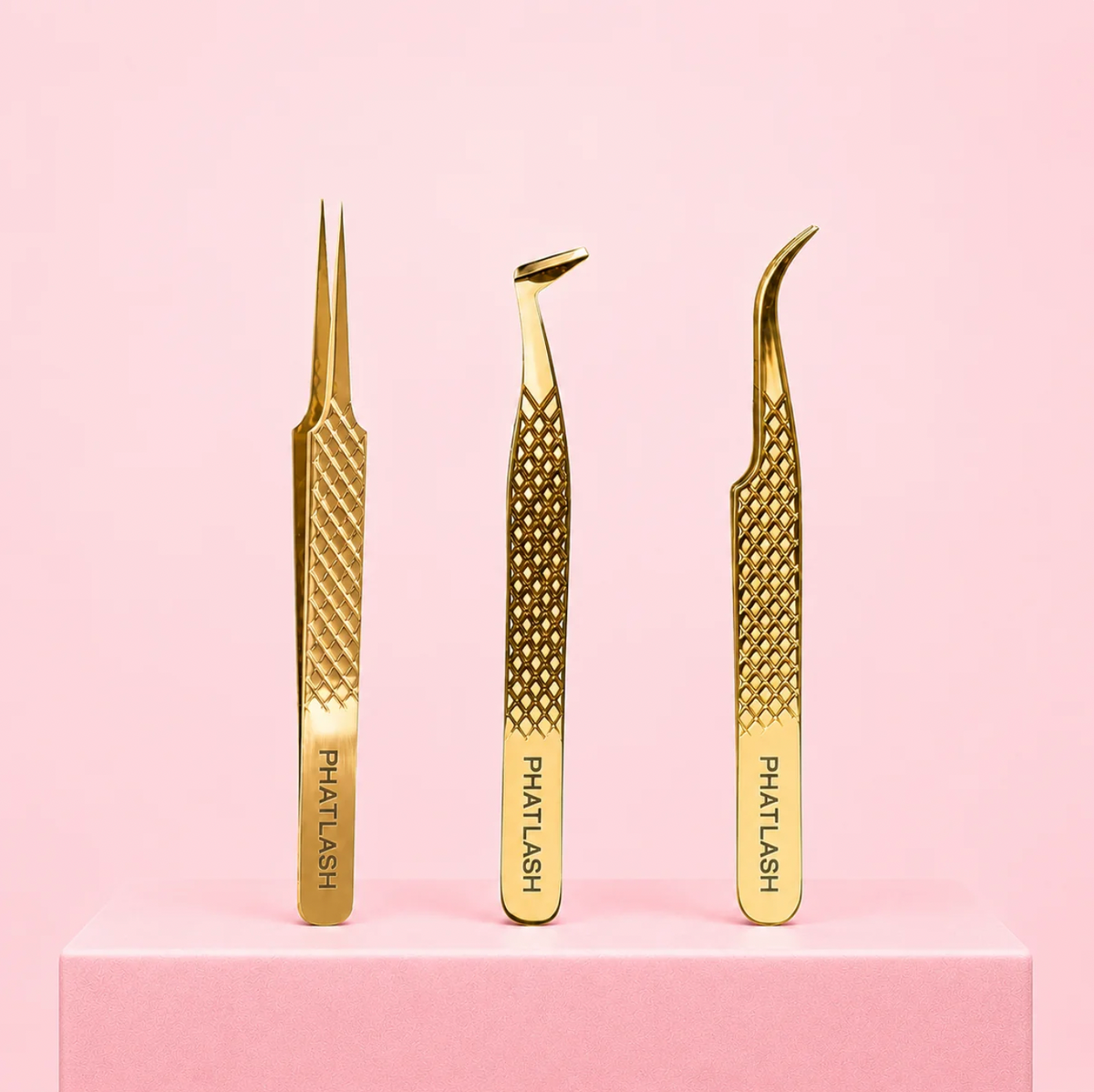
1. Straight Lash Tweezers
Straight tweezers are one of the most popular styles used by lash technicians, particularly for isolation.
As the name suggests, the tips are straight rather than curved or angled. This allows you to approach the natural lash from a direct angle.
If you're building your lash kit with Phatlash, straight tweezers are a style worth considering for your isolation work.
What Are Straight Tweezers Used For?
Straight tweezers are commonly used for:
-
Isolating individual natural lashes.
-
Separating lashes that are stuck together.
-
Holding natural lashes in place during application.
-
Classic lash application, depending on the design.
-
Working with natural lashes in different areas of the eye.
Their slim, straight design can make it easier to see where the tweezer tips are positioned.
Are Straight Tweezers Good for Beginners?
Yes! Straight tweezers are a popular option for beginners because they are relatively simple to position and can be used for a range of isolation tasks.
However, choosing the right pair is important. The tips should meet evenly and close comfortably without requiring excessive pressure.
Phatlash tip: If you're new to lashing, practise isolating individual natural lashes with straight tweezers before moving on to more advanced techniques.
2. Isolation Tweezers
Isolation tweezers are designed specifically to help you separate individual natural lashes before applying an extension.
Isolation is one of the most important parts of lash application. Each extension must be attached to an individual natural lash, so you need to ensure that neighbouring lashes aren't stuck together.
Isolation tweezers are often slim, lightweight and designed with fine tips to help you work precisely.
What Are Isolation Tweezers Used For?
Their main purpose is to separate natural lashes so that you can apply extensions safely and accurately.
They can help you:
-
Separate individual natural lashes.
-
Identify suitable natural lashes for extension placement.
-
Check that neighbouring lashes aren't attached together.
-
Release lashes that have become stuck during application.
-
Maintain clear visibility around the lash line.
What Shape Are Isolation Tweezers?
Isolation tweezers are commonly straight, but some designs have slightly angled or curved tips.
This means isolation tweezers aren't necessarily one specific shape. The term describes their intended use rather than a single design.
For example, you might prefer straight isolation tweezers, while another lash technician may find angled isolation tweezers more comfortable.
Why Is Isolation So Important?
If multiple natural lashes become bonded together, they may pull against each other as they grow. This can cause discomfort and potentially damage the natural lashes.
Correct isolation allows each natural lash to move independently and supports healthy lash extension application.
At Phatlash, we always recommend prioritising correct isolation and checking your work throughout the appointment, rather than leaving it until the end.
3. Angled Lash Tweezers
Angled tweezers feature tips that bend at an angle rather than continuing in a completely straight line.
The angle can make it easier to approach natural lashes from different directions and may provide a more comfortable hand position for certain lash artists.
Depending on the design, angled tweezers can be used for isolation, classic application or volume techniques.
What Are Angled Tweezers Used For?
Angled tweezers can be useful for:
-
Isolating natural lashes from a different approach angle.
-
Picking up individual lash extensions.
-
Classic lash application.
-
Creating handmade volume fans, depending on the tip design.
-
Working around areas where a straight tweezer feels awkward.
Are Angled Tweezers Good for Isolation?
Yes, some angled tweezers work well for isolation.
The angled shape may allow you to see the natural lashes more clearly or position your hand more comfortably, depending on your working angle.
However, not every angled tweezer is designed for isolation. Some have tips that are better suited to picking up extensions.
Are Angled Tweezers Good for Volume?
Certain angled tweezers can be used for volume application, especially if the tips close evenly and provide enough grip to control your extensions.
When choosing angled tweezers from Phatlash, consider whether you're looking for a pair for isolation, picking up individual lashes or creating handmade fans.
4. Curved Lash Tweezers
Curved tweezers have a curved or rounded shape towards the tips.
They are particularly popular among lash technicians who create handmade volume fans because the curved design can provide a comfortable angle for picking up and positioning extensions.
However, curved tweezers can come in different shapes and degrees of curvature, so not every pair will feel the same.
What Are Curved Tweezers Used For?
Curved tweezers are commonly used for:
-
Picking up lash extensions.
-
Creating handmade volume fans.
-
Russian volume application.
-
Placing fans accurately onto natural lashes.
-
Working at different angles around the eye.
Why Do Lash Artists Use Curved Tweezers?
The curved design can allow you to approach the lash strip and natural lash from a different angle compared with straight tweezers.
For some artists, this makes it easier to see the extension and control the fan during placement.
Curved tweezers are particularly popular for volume work because they can be used to pick up and manipulate multiple fine extensions.
Are Curved Tweezers Suitable for Beginners?
They can be, especially if you're learning volume techniques.
However, beginners may find it easier to start with a tweezer that feels comfortable and closes accurately, rather than choosing a style simply because it's popular.
If you're learning Russian volume, practise picking up extensions and forming fans before using them on a client.
5. Boot Lash Tweezers
Boot tweezers are a popular choice for lash technicians who create handmade volume fans.
They have a distinctive shape, with an angled section that leads into a flatter gripping area at the tip. The design resembles the shape of a boot, which is where the name comes from.
Boot tweezers are often used for Russian volume because the wider gripping area can help you pick up and control multiple extensions.
What Are Boot Tweezers Used For?
Boot tweezers are commonly used for:
-
Russian volume lash application.
-
Creating handmade volume fans.
-
Picking up multiple fine extensions.
-
Controlling the base of a fan.
-
Working with different volume techniques.
Why Are Boot Tweezers Popular for Volume?
The shape can provide a useful gripping surface when picking up extensions from the lash strip.
Depending on the tweezer design and your technique, the flatter tip can help you hold the extensions together while creating a fan.
Some lash artists find boot tweezers particularly comfortable for creating fans using the strip-pickup method.
Are Boot Tweezers Suitable for Classic Lashes?
They can be used for picking up individual extensions, but their design is generally associated with volume techniques.
If you're mainly applying classic lashes, you may prefer a straight or angled tweezer that gives you a more precise grip on a single extension.
Are All Boot Tweezers the Same?
No! Boot tweezers can vary in their angle, tip width, length and closing pressure.
Some have a wider gripping surface, while others are much finer.
When choosing boot tweezers from Phatlash, consider the size of the extensions you're using and the way you create your fans.
6. 90-Degree Lash Tweezers
90-degree tweezers have a pronounced right-angle bend near the tip.
They are commonly used for volume lash application and can be particularly useful for lash artists who prefer a more upright or precise approach when picking up extensions.
The right-angle design creates a different working position compared with straight, angled or curved tweezers.
What Are 90-Degree Tweezers Used For?
They are commonly used for:
-
Picking up volume lash extensions.
-
Creating handmade fans.
-
Russian volume application.
-
Controlling the base of a fan.
-
Working with different fan-making techniques.
Why Choose 90-Degree Tweezers?
The right-angle shape can help you approach the lash strip from a different direction.
Some lash artists find that this gives them greater control when picking up extensions or forming fans.
They can also be useful if you prefer to keep your hand in a particular position while working.
Are 90-Degree Tweezers Good for Beginners?
They can be, but they may take some practice if you're used to using straight or curved tweezers.
If you're learning volume, try different styles to see which one allows you to pick up extensions comfortably and consistently.
Remember, a 90-degree tweezer isn't automatically better for volume than a boot or curved tweezer. It comes down to the design, your technique and how well the tips meet.
Which Lash Tweezers Are Best for Each Technique?
Now we've covered the different styles, let's look at which tweezers you may want to use for different lash techniques.
At Phatlash, we stock a range of lash tweezers to help lash technicians find tools that suit their preferred application style.
Classic lash application
Straight or angled tweezers can be useful for picking up individual extensions, while a separate isolation tweezer helps you isolate each natural lash.
Russian volume
Boot, curved or 90-degree tweezers are popular options for creating handmade fans. Choose the shape that gives you the best grip and control.
Isolation
Straight or angled isolation tweezers can help separate natural lashes. Choose fine tips that meet accurately.
Wispy and textured sets
Curved or volume tweezers can help you pick up and position fans and spikes, depending on the technique you're using.
How to Choose the Right Lash Tweezers from Phatlash
With so many options available, choosing the right tweezers can feel overwhelming. Here are some things to consider before adding a new pair to your lash kit.
1. Consider Your Lash Technique
The first thing to think about is the type of lash extensions you apply most often.
If you mainly create classic sets, you may prefer straight or angled tweezers for picking up individual extensions.
If you specialise in Russian volume, you may want to try boot, curved or 90-degree tweezers.
If you offer a mixture of techniques, having different styles available can make it easier to switch between them.
2. Check the Tip Alignment
One of the most important things to look for is how well the tweezer tips meet.
When the tips close, they should meet evenly without leaving gaps or overlapping awkwardly.
Poorly aligned tweezers can make it difficult to pick up extensions securely and may cause frustration during application.
Always test your tweezers before using them on a client.
3. Consider the Weight and Comfort
You may be holding your tweezers for several hours a day, so comfort is important.
Look for tweezers that feel comfortable in your hand and don't require excessive pressure to close.
If your tweezers feel too heavy or difficult to control, they may become uncomfortable during longer appointments.
4. Think About the Extensions You Use
Different lash extensions require different levels of control.
For example, if you regularly work with very fine volume lashes, you may prefer tweezers that allow you to pick up and manipulate lightweight extensions accurately.
If you mainly use classic extensions, a tweezer designed for picking up individual lashes may be more suitable.
5. Try Different Styles
You don't need to choose your forever tweezers straight away!
Try different styles and see how they feel during practice.
You may find that you prefer one tweezer for isolation and another for volume fans.
Over time, you'll develop your own preferences based on the techniques you use most often.
How to Look After Your Phatlash Tweezers
Once you've found your favourite tweezers, it's important to look after them properly.
Lash tweezers are precision tools, and keeping them clean and in good condition helps maintain their performance.
Clean your tweezers after every client
Follow the manufacturer's cleaning and disinfection instructions and use products suitable for your tweezers.
Make sure you remove any adhesive residue carefully without damaging the tips.
Store them safely
Keep your tweezers in a protective case or holder when they aren't being used.
Avoid leaving them loose in your lash trolley, where the tips could become damaged.
Avoid dropping them
Dropping tweezers can affect the alignment of the tips, making them harder to use.
Even if they look fine, check that they still close evenly before using them again.
Check the tips regularly
If your tweezers no longer meet properly or become difficult to use, it may be time to replace them.
Never continue using damaged tweezers on a client if they affect your ability to work safely and accurately.
Frequently Asked Questions About Lash Tweezers
What tweezers do lash technicians use?
Lash technicians commonly use isolation tweezers to separate natural lashes and a second tweezer to pick up and apply extensions.
The style of application tweezer depends on whether they're performing classic, hybrid or volume lash extensions.
Are fibre tip tweezers better than non-fibre tip tweezers?
Neither is automatically better. Fibre tip tweezers have a textured gripping surface, while non-fibre tip tweezers have a smooth finish.
Some lash artists prefer fibre tips for volume fans, while others prefer traditional smooth tweezers.
What are boot tweezers used for?
Boot tweezers are commonly used for Russian volume lash application and handmade fan creation.
Their angled shape and gripping surface can help lash artists pick up and control multiple fine extensions.
What are 90-degree tweezers used for?
90-degree tweezers are commonly used for volume lash application. Their right-angle design can help lash artists approach the lash strip and create fans from a different working angle.
Can I use curved tweezers for isolation?
Some curved tweezers can be used for isolation, but it depends on the design and how accurately the tips meet.
Many lash technicians prefer straight or angled tweezers specifically for isolation.
How many tweezers should a lash technician have?
There isn't a set number, but many lash technicians keep at least two pairs available: one for isolation and one for picking up extensions.
If you offer different lash techniques, you may find it useful to have several styles so you can choose the most suitable tool for each application.
Find Your Perfect Lash Tweezers at Phatlash
Whether you're a beginner building your first lash kit or an experienced lash technician looking to upgrade your tools, choosing the right tweezers can make a real difference to your application.
From straight isolation tweezers to curved, boot and 90-degree volume tweezers, there are plenty of options to suit different techniques and preferences.
At Phatlash, we stock a range of lash tweezers to help you find the right tools for your lash kit.
Explore our tweezer collection and find your new favourite pair for your next set of lashes!
Remember: The best tweezers are the ones that feel comfortable in your hand, close accurately and give you the control you need to create beautiful lash sets.
Comments